> ## Documentation Index
> Fetch the complete documentation index at: https://aspect.build/llms.txt
> Use this file to discover all available pages before exploring further.
# Integrate Python console scripts as tools
> Integrate Python console scripts like Jinja2 as build-time tools in Bazel, pinning them via requirements and invoking their CLIs from BUILD rules.
Now, let’s add a new build step that generates code, which is a common requirement in real-life projects.
For today, we'll use a popular templating engine called Jinja.
Bazel is not opinionated about what tools you use, AND it’s not necessary to write any custom rules or macros to call existing tools using their CLI.
In fact, it’s quite easy.
## Fetch the jinja2 tool
Add to the `requirements/tools.in` file, which is where you organized dependencies that are only used at build time.
```bash theme={null}
echo "jinja2-cli" >> requirements/tools.in
```
Repin the transitive dependencies again: `./tools/repin`
## Tell Bazel how to run it
Open the BUILD file in the `tools` folder. There’s already a `py_console_script_binary` rule which you used to run the `copier` tool.
Make an identical one for jinja2.
The package name with a hyphen was converted by rules\_python to be an underscore here!
That's not necessarily the same thing as the string you use in `import`.
Also add a `visibility` attribute, since Bazel enforces that the dependency graph doesn’t get tangled by default.
```bash theme={null}
py_console_script_binary(
name = "jinja2",
pkg = "@pip//jinja2_cli",
visibility = ["//visibility:public"],
)
```
Now check that you can run it:
```bash theme={null}
% bazel run tools:jinja2
...
INFO: Build completed successfully, 5 total actions
INFO: Running command line: bazel-bin/tools/jinja2
Usage: rules_python_entry_point_jinja2.py [options]
Options:
--version show program's version number and exit
-h, --help show this help message and exit
--format=FORMAT format of input variables: auto, env, ini, json,
querystring
-e EXTENSIONS, --extension=EXTENSIONS
extra jinja2 extensions to load
-D key=value Define template variable in the form of key=value
-s SECTION, --section=SECTION
Use only this section from the configuration
--strict Disallow undefined variables to be used within the
template
-o FILE, --outfile=FILE
File to use for output. Default is stdout.
```
This shows that you can run the tool under Bazel.
It also prints the help text for the CLI, which is critical for the next step: invoking it with the right arguments.
## Declare the code generation
The library already came with a jinja2 template file in `mylib/header.tmpl.txt`.
You can see it has a `{{TIMESTAMP}}` placeholder to fill in.
To help out, the library also has a `run_binary` rule in the `mylib/BUILD` file.
This is a basic building block which uses a tool and some declared inputs, then runs it when needed to produce the declared outputs.
You can see the `args` already match the command-line flags from the jinja2 help output above.
The `tool = "TODO"` line is ready for you to fill in with the jinja2 CLI you just setup. Replace that with the label `//tools:jinja2`.
Now you can run a `build` to check the codegen:
```bash theme={null}
bazel build mylib:header.txt; cat bazel-bin/mylib/header.txt
INFO: Analyzed target //mylib:header.txt (0 packages loaded, 0 targets configured).
INFO: Found 1 target...
Target //mylib:header.txt up-to-date:
bazel-bin/mylib/header.txt
INFO: Elapsed time: 0.146s, Critical Path: 0.00s
INFO: 1 process: 1 internal.
INFO: Build completed successfully, 1 total action
-- Built at --
I'm a cow, I found this on the internet
```
It worked!
Why does the value say `` though? This is “determinism” where the output of a build step should only depend on the inputs.
If the current timestamp appears here, the output will be different every time, causing cache misses for any action that depends on this one, even transitively.
That slows down builds! You’ll see how to stamp artifacts for production later.
## Depend on the codegen
Finally, use the new templated header file in the application.
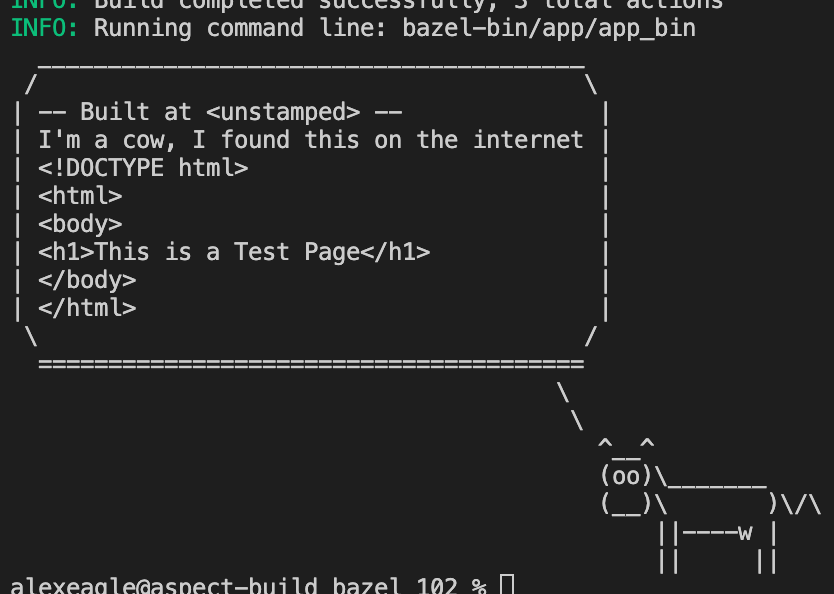
The `mylib` library included a second function, `stamped`, so change the `marvin` function in `app/__main__.py` to use that instead.
When you try to run the application now you get an error:
```bash theme={null}
bazel run //app:app_bin
Traceback (most recent call last):
File "execroot/_main/bazel-out/darwin_arm64-fastbuild/bin/app/app_bin.runfiles/_main/app/__main__.py", line 6, in
say.stamped(x.text)
File "execroot/_main/bazel-out/darwin_arm64-fastbuild/bin/app/app_bin.runfiles/_main/mylib/say.py", line 14, in stamped
with open(path.join(FOLDER, "header.txt"), "r") as header:
^^^^^^^^^^^^^^^^^^^^^^^^^^^^^^^^^^^^^^^^^^
FileNotFoundError: [Errno 2] No such file or directory: 'mylib/header.txt'
```
This error says that you didn’t declare the `header.txt` file as a dependency.
And because the reference isn’t an `import` statement, BUILD file generation is not smart enough to know what to do.
To fix this, you need to edit the BUILD file by hand.
Since it’s a runtime dependency, you need to list it as a `data` dependency. How do you know where it belongs though?
The answer is the “locality principle”. You should declare the dependency locally to where the reference appears.
There should always be a symmetry between the symbol reference in the code, and the BUILD definition for that file.
Since the stack trace points to `say.py` , you should add the `data` dependency next to the `srcs=["say.py"]` declaration:
```bash theme={null}
py_library(
name = "mylib",
srcs = ["say.py"],
data = ["header.txt"],
visibility = ["//:__subpackages__"],
deps = ["@pip//cowsay"],
)
```
Now run the app and see the header appears:
This documentation is built and hosted on [Mintlify](https://mintlify.com), a developer documentation platform.
 This documentation is built and hosted on [Mintlify](https://mintlify.com), a developer documentation platform.